You've noticed it everywhere: download a PDF, read an article, get a discount code, create a free account — every step requires your email address. Even when there's no obvious reason for the site to need it.
This isn't accidental. Email addresses are valuable in ways that aren't obvious to most users. Understanding exactly why websites want your email — and what they do with it — helps you make better decisions about when to give your real address and when to use a disposable one.
The Real Value of an Email Address
To a company, your email address is not just a way to contact you. It's a persistent identity anchor that links your activity across platforms, devices, and time.
Here's what an email address enables for a business:
Direct marketing channel — Email has the highest ROI of any marketing channel. Companies can reach you directly, repeatedly, at near-zero cost. An email list of 100,000 addresses is worth tens of thousands of dollars in marketing value annually.
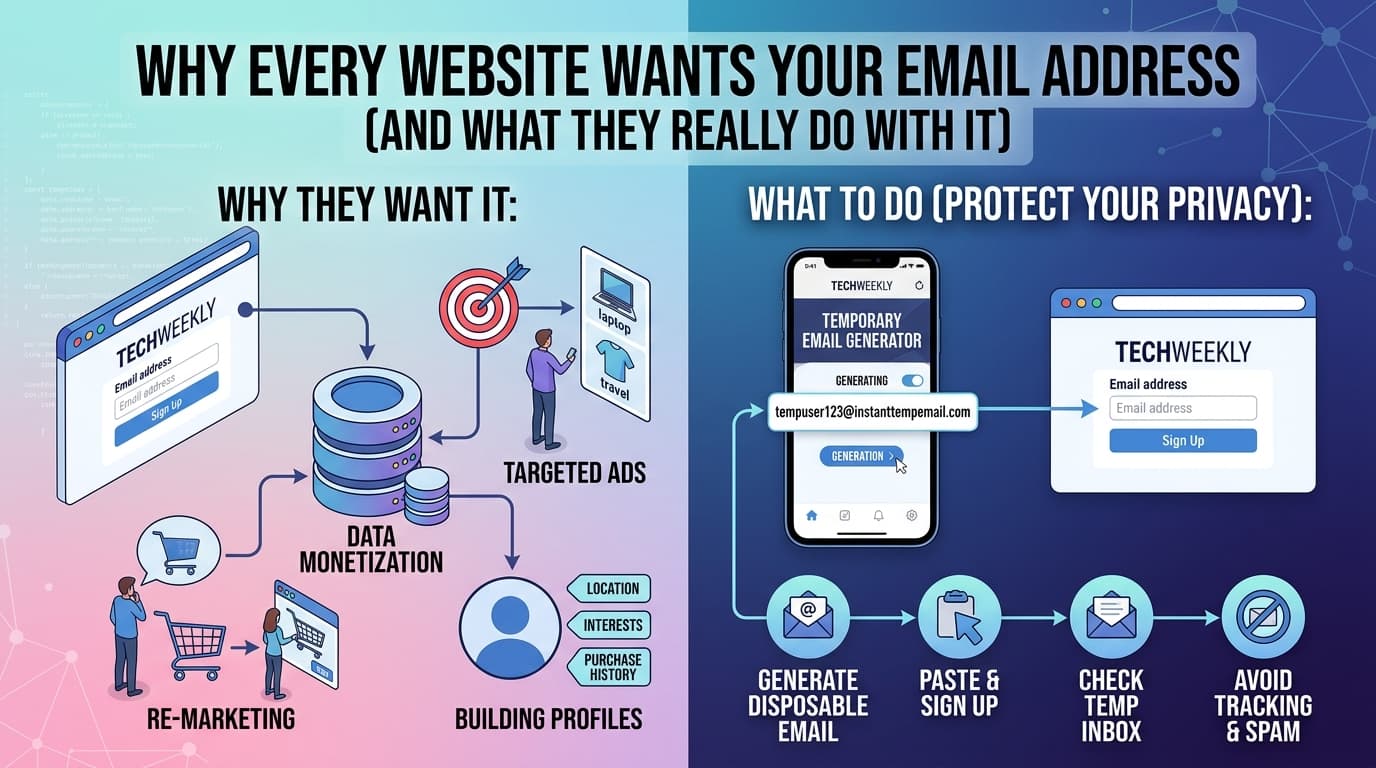
Cross-platform tracking — Your email address can be hashed (converted to a scrambled code) and matched against hashed emails in advertising platforms. If you've ever given your email to Facebook, Google, or a major retailer, advertisers can target you by uploading your email to these platforms — even if you've never visited their site directly.
Identity linking — Data brokers combine email addresses with other data points (name, address, phone number, purchase history) to build detailed consumer profiles. Your email is often the key that links these records together.
Account recovery and authentication — The practical reason: they need a way to verify your identity and let you recover your account. This is legitimate for real accounts.
Audience building for resale — Some businesses exist primarily to collect email addresses and sell them. Free tools, quiz sites, and contest entry forms are common examples.
What Companies Do With Your Email: The Full Chain
When you give your email to a website, here's what can happen next:
1. They add it to their marketing list
This is the most common and expected outcome. You start receiving emails from the company — promotional offers, newsletters, product updates. The frequency and relevance vary widely.
2. They share it with "partners"
Most privacy policies include language about sharing with "trusted partners," "affiliates," or "third-party service providers." In practice, this can mean:
- Email service providers (Mailchimp, SendGrid, HubSpot) — see your address to send on the company's behalf. These providers have their own data practices.
- Analytics platforms — your email may be hashed and sent to Google Analytics, Mixpanel, or similar tools to track your behavior across sessions.
- Advertising platforms — your email is uploaded to Facebook Custom Audiences, Google Customer Match, or similar tools so the company can target you with ads elsewhere.
- Affiliate partners — other companies in the same industry who've paid for list access.
3. They sell it to data brokers
Data brokers — companies like Acxiom, Experian Marketing (separate from the credit bureau), LiveRamp, and hundreds of smaller players — purchase email lists from websites and aggregate them into massive consumer databases.
These databases are then licensed to other businesses for marketing purposes. Your email from a cooking website signup might end up in a financial services marketing list.
4. It gets breached
Even companies with good intentions can be breached. A database containing your email — along with potentially your name, password, and other details — gets stolen and circulates in breach networks.
5. It persists indefinitely
Unlike a cookie, which expires, or an IP address, which changes, your email address is stable for years or decades. Data collected today can be used against you in marketing or fraud attempts years from now.
How to Identify High-Risk Email Collection
Not all email collection is equal. Here are signals that a particular site is more likely to misuse your address:
High risk:
- The site's primary value proposition is "free" content, tools, or resources
- The privacy policy mentions "partners," "affiliates," or "third-party marketing" extensively
- There's no clear reason for the site to need your email for the service it's providing
- The site hosts contests, giveaways, or prize draws
- The email field appears before any real value is delivered (email-gate before content)
- The company is in the lead generation, coupon, or deals industry
Lower risk:
- The service is a paid product where the company's revenue comes from subscriptions, not data
- The company's privacy policy is specific about exactly what they do with data and explicitly says they don't sell it
- The email is used only for account creation and security (not marketing)
- The company has a strong brand reputation they'd risk by misusing data
The Email Gate: What's Actually Happening
An "email gate" is when a site requires your email before letting you access content — a PDF download, a free tool, a webinar recording.
Behind the scenes, this is typically a lead generation system:
- You enter your email
- It goes into a CRM (like HubSpot or Salesforce) tagged with the content you accessed
- You're automatically added to an email nurture sequence
- If you work for a company, your email domain may be used to identify your employer
- A salesperson may be alerted that someone from your company accessed the content
- Your email may be enriched — cross-referenced with LinkedIn or contact databases to find your job title, company size, and contact information
For B2B companies, this is the entire point of the gate — not to restrict access to the content, but to generate sales leads.
Using a temporary email from InstantTempEmail gets you the content without entering this pipeline.
When It's Worth Giving Your Real Email
Being strategic about your email doesn't mean never giving your real address. It means being intentional.
Give your real email when:
- You're creating an account you'll use long-term and need reliable access to
- The service sends emails that are genuinely valuable to you (and you've verified this through experience)
- You're buying something and need order confirmations and receipts
- Account recovery via email is important (banking, healthcare, government services)
- You want to build a long-term relationship with the company or creator
Use a temporary or alias email when:
- You need to access content that's gated behind an email form
- You're signing up for a trial you might not continue
- You're creating an account on a site you'll use once or rarely
- You're not confident in how the company handles data
- The site clearly exists to generate leads rather than provide ongoing service
What Happens When You Unsubscribe
Clicking "Unsubscribe" stops the marketing emails (usually). It does not:
- Remove your address from their database
- Remove your address from lists already sold to data brokers
- Prevent your address from being used for ad targeting
- Prevent your address from being exposed in a future breach
- Stop all email — transactional emails (receipts, security alerts) continue
The unsubscribe mechanism exists because of legal requirements (CAN-SPAM in the US, GDPR in Europe). It's the minimum compliance action, not a comprehensive data deletion.
If you want actual data deletion under GDPR (if you're in Europe), you can submit a formal "right to erasure" request. This legally requires the company to delete your personal data, not just stop emailing you. The process is more involved but more complete.
The GDPR and CCPA: Your Legal Rights
Depending on where you live, you have legal rights over your personal data:
GDPR (Europe):
- Right to access — request a copy of all data the company holds about you
- Right to erasure ("right to be forgotten") — request deletion of your data
- Right to data portability — receive your data in a machine-readable format
- Right to object to processing — object to your data being used for marketing
CCPA (California):
- Right to know what data is collected and shared
- Right to delete personal information
- Right to opt out of the sale of your data
- Right to non-discrimination for exercising these rights
To exercise these rights, look for a "Privacy" or "Data Request" link in the company's website footer. Most companies have a process for this (legally required under these regulations). It takes effort, but it works.
Frequently Asked Questions
Is it illegal for companies to sell my email address without permission? In the EU under GDPR, selling personal data without explicit consent is illegal. In the US, it depends on the state and context — there's no comprehensive federal law. Most companies technically get "consent" through privacy policies that users agree to without reading during signup.
Why do companies ask for email even when I'm just browsing? Pop-ups and inline email capture forms on content sites are primarily lead generation. The company wants your email to build a marketing list, regardless of whether you've bought anything or created an account. You're under no obligation to provide it.
Can I ask a company to delete my email from their database? Yes, and in many jurisdictions they're legally required to comply. Look for a "data deletion request" or "privacy request" form on their website. GDPR-compliant companies (serving EU users) are legally required to have this process.
Does using a fake name with my real email help? Slightly — it prevents name-based targeting and makes data enrichment harder. But your email address itself is still a persistent identifier. A temporary or alias email protects the identifier itself, which is more valuable than obscuring the name.
How do data brokers get my email in the first place? They purchase it from websites, compile it from public sources (forum posts, comment sections, business listings), receive it from loyalty programs and retail point-of-sale systems, and aggregate it from breach data. Your email has likely entered broker databases through multiple channels.